Recently in 2 wheel Category

The weather was finally nice enough to commute to work this week on my Piaggio Boxer EV with Prius NiMH batteries.

Here's the data from my CycleAnalyst:

Run #1
1.18
(To)
Run #2
1.18
(From)
Run #3
1.19
(To)
Run #5
1.20
(To)
Distance5.2 km4.85 km4.21 km4.19 km
Efficiency45.1 Wh/km39.2 Wh/km42.2 Wh/km47.6 Wh/km
Energy used234.23 Wh189.87 Wh176.92 Wh199.03 Wh
Charge Used5.90 Ah4.28 Ah4.01 Ah5.01 Ah
Max Amps106 A101 A91 A101 A
Average Speed20.6 km/h23.3 km/h24.8 km/h24.1 km/h
Max Speed36.6 km/h40.3 km/h39.0 km/h36.6 km/h
Starting voltage---49.950.247.2
Ending voltage43.8v45.9v---44.2v
Run time15 min12:3010:1010:24

My commute is slightly uphill on the way to work and downhill on the way back, which accounts for the difference in energy efficiency going to and from work.

The bike feels much lighter than with the SLAs and faster too (even with the gear reduction) so I have to say it's an unqualified success. I just hope I can get good life out of these batteries.

After Run #4, I was in a rush and so I put the charger on and went to a talk and then came back. About 3 hours had passed and the charger had over charged the batteries. It actually wedged the battery holder apart. So I'm worried now that my batteries will be weakened -- even though most of the bulging has subsided.

I reinforced the battery holder this morning and we'll see how it holds up.

I just bought a cute little folding bike. At first I thought it was a Brompton but a little more research shows that it's most probably an Italian bike, my best guess is the Amica built by the Carnielli bike company. I'm not positive since someone repainted the bike a horrendous orange.

EV Warrior Drive Roller

| | Comments (0)

I'm working on a bicycle assist motor project. I thought about using a hub motor or chain drive but given the economy, I'm going with a friction drive. Friction drive is cheap, has few little moving parts to go wrong, and is cheap. I think I can make it using parts almost entirely found around the shop -- with the exception of the friction roller.

Now what I like about friction drive is if you use a roller with a one-way bearing and take advantage of some physics, the motor can release from the wheel entirely when freewheeling, so the bicycle remains entirely pedal-able on its own.

I decided to go with rollers from the defunct EV Warrior project. They're available on the surplus market, have one way bearings, and are nicely knurled. Other people are making their own friction rollers from BMX wheel hub extensions, but they don't have one-way bearings.

Here are some dimensions almost entirely for my own benefit.

PartInchmm
Shaft OD0.500"12.70mm
Shaft ID0.315"
(a tad over 5/16")
8.00
Shaft Width3.016"76.61
Roller Width2.375"
2 3/8"
60.35
Roller OD1.275"
~1 1/4"
32.38
Key Notch Width0.130"3.32
Key Notch Depth0.411"10.4

I have the Prius NiMH batteries installed and test drove it but the snowstorm of 2009 has put the dampers on harder testing. In any case, here's the new revised bill of materials (BOM) (dated 2009.12):

Base Unit Piaggio Boxer (1971)
- 50 cc 2-stroke internal combustion engine (removed)
Electric Motor HXT 80-100-B 130Kv Brushless Outrunner from United Hobbies
- link to new version of motor
- Tachs: 5600 rpm @ 43.2v nominal (4500 rpm @ 36v; 6000 rpm @ 48v)
- Max amps drawn: 100A @ 43V
- Max watts drawn: ~ 4300 watts
- Speed: 45 kph top speed (at current gearing)
Electronic Speed Controller Castle Creations Phoenix HV-110 (link)
- 110 amps @ 50 volts limit
Throttle Magura 0-5K Potentiometer motorcycle twist grip throttle
Servo Tester (Pot to ESC) Boman Industries Polar-Matic PC-50 (ebay)
Power Monitor Cycle Analyst (link)
Batteries Currently SLA: Prius Gen 2 NiMH
- 6S2P packs (12 in total)
- 43.2 volts nominal @ 13 Ah
- 330 watt-hours (conservative)
- Range: unknown
Power Connectors - Anderson PowerPole 75A on main connections - link
- Anderson PowerPole 30A on sub connections - link
Wiring - 8 gauge stranded copper on main power lines and motor leads
- 12 gauge stranded copper on sub power lines
Lighting - Front lighting using high-power Luxeon LED
- Rear lighting using high-power red LEDs
Low Voltage (12/5VDC) Converters
  1. 12VDC converter using National Semiconductor LM2576HVT-12-ND buck-converter for motor cooling fan, front lighting (via 5vdc) and rear lighting
  2. 12 volt to 5VDC converter using MC34063 Based Switching Regulator for front lighting
  3. Another 12VDC converter using National Semiconductor LM2576HVT-12-ND buck-converter for ESC controller cooling
  4. Quark Pro BEC 3A UBEC for servo tester / RC components
Things I burned out/destroyed
  • E-Sky EK2-0907 Servo Tester
  • Doc Wattson power monitor
  • ELF 100 ESC speed controller
  • Castle Creations Phoenix HV-110
  • Right index finger on burnt out ESC
  • Various burns and scrapes

RC brushless motors

| | Comments (0)

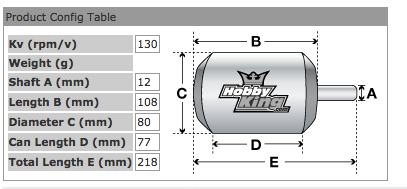
When I first started building my Boxer-EV, the motor I installed in it was the largest brushless motor available for RC systems:

Model: HXT80-100-B
Wire Turns: 8
Resistance: 32ohm
Idle Current: 2A
ESC Required: 130A
Input Voltage : max. 48V 
Kv : 130 rpm/V 
Weight: 1570g
Shaft: 12mm
Voltage Range: 20-48v
Non Load Current: 2.0A
Maximum Power: 6500W
Equivalent: 60-80cc Gas Engine

I've been very happy with it. With my 48 volt setup, I'm producing enough power that my drive belt started slipping -- so I reduced the gearing a bit to back off the torque. Still, vroom vroom.

ProgressiveRC.com has a great online list of RC brushless motors and you can sort by watts consumed. Looks like there are some great 10,000 watt motors (holy cowabunga!) the only problem being they are around US$2000 and above. My $130 + shipping RC motor is still on the top of the price/performance curve.


It looks like the dealer in Hong Kong I get things from has come out with a new version of the motor. The specs seem the same but they note: "Tight, thick copper windings and 48SH magnets make this motor a real powerhouse. The v2 motor also has screwed end-caps due to the amount of torque this motor produces!"

HXT80-100-A.jpg
HXT80-100B.png
Model: TR80-100-B
Wire Turns: 8
Resistance: 32ohm
Idle Current: 2A
ESC Required: 130A
Input Voltage : max. 48V 
Kv : 130 rpm/V
Weight: 1570g
Shaft: 12mm
Voltage Range: 20-48v
Non Load Current: 2.0A
Maximum Power: 6500W
Equivalent: 60-80cc Gas Engine

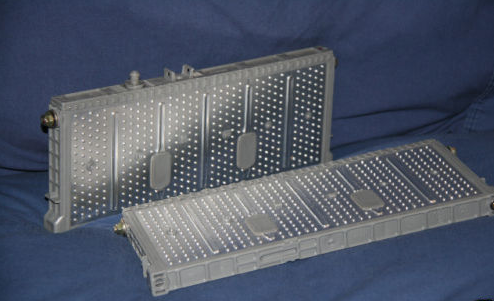
PriusGenIINiMH.pngI just won a bid for twelve Prius packs! They should hopefully be arriving later this week or early next.

Update: Batteries arrived and ready to be installed!

Each pack is a 7.2 volts 6.5 Ah prismatic NiMH battery with six cells. I'll be configuring them as 6S2P for 43.2 volts 13 Ah. I'm hoping that I can get at least 60% of the SOC from them (80% to 20% as on the Prius). That would be 43 volts, 7.8 Ah or 335 watt-hours.

This is perfect as I'm currently consuming 200 watts-hours each way with the heavy SLAs. The lighter NiMH packs should get my power consumption down even lower.

TypeDescriptionWhWeight
SLATempest TR35-12 (rated 35Ah)
-- 35 Ah @ 36 volts
-- I don't get 35Ah, closer to 10 Ah due to Peukerts

Specific Energy 35 Wh/kg nominal
Specific Energy 10 Wh/kg derated
360 Wh 1 @ 11.8 kg
3 @ 35.4 kg (78 lb)
NiMHPrius Gen II Battery (rated 6.5Ah) @ 1040 grams
-- 13 Ah @ 43.2 volts
-- derated 60% for a conservative Ah of 7.8 Ah

Module Weight 1040 g
Specific Power 1300 W/kg

Specific Energy 46 Wh/kg nominal
Specific Energy 27 Wh/kg derated
335 Wh 1 @ 1.04 kg
12 @ 12.48 kg (27.5 lb)

It looks like I'll be saving a good 20 kilograms or 50 pounds with only a slight loss in Watt-hours! I will have to bodge up a new battery carrier as the cells need to be kept under compression when being charged.

Revised bill of materials (BOM) (dated 2009.09):

[moved to after the jump]

This is the post-flameout, rebuilt Piaggio Boxer EV. I changed the battery carrier from a top-mount system to saddle bags. This lowers the center of gravity and makes it easier to handle. I'm going to replace the seat with something more classic looking.

P1050018.jpg


I welded the saddlebag carriers myself from steel tubing with my MIG welder.

P1050020.jpg

The Electronic Speed Controller (ESC) is sitting on top. It's the replacement HV-110 that I received from Castle Creations with additional capacitors soldered in parallel on the input lines.

P1050030.jpg


It's sitting in a Lexan enclosure that I bodged together. Unlike the old metal enclosure with a single temperature controlled fan, the new enclosure uses two fixed speed fans that pull the air across the ESC and the voltage converters (sitting below). They also are assisted by draft air when the vehicle is at speed.

P1050023.jpg

This photo was taken a few minutes after a short run, the temp of the caps is 34 centigrade which is nominal. Anything less than 60 centigrade I think will be ok. The caps are rated at 85C.

Although the angle of the photo above makes it look like the ESC could short out on the voltage converters, it's actually held a centimeter or so above and everything is well insulated.

My little Piaggio-EV is back up and running. I made the following mods:

  • My replacement HV-110 is now installed in an external plexiglass box with (much) better airflow and forced as well as passive air cooling. The forced cooling is on full all the time rather than the temperature variable fan that I used to have.
  • Extra caps (470 uF x 6) soldered in parallel with input leads
  • (Slightly) beefier wiring used -- 8 gauge rather than 12 ga
  • 75 amp Andersen PowerPoles used instead of 30A
  • Wiring shortened a bit
  • Thermometer probe directly on caps to monitor heat

So far, it seemed ok. After my ride to work this morning, the caps heated up a bit -- from 17°C ambient at the beginning to 37°C ambient at the end of the 5 kilometer ride. I'm working on getting even more cooling in there.

6 amps used. 30 watts/kilometer average energy expenditure.

My Piaggio hit the dust a few weeks ago. I went to school with no problems and was on my way back when I heard a loud pop, lost power, and an acrid smoke started pouring out of the ESC/electronics components.

I finally got around to taking the electronics out this weekend. It looked like the Phoenix HV-110A hit the dust.

I was using 2S Pb (SLA) and my max watts were under 100A the entire time (according to my wattmeter). The HV-110 burst into flames when the moped was being driven under relatively light load. This is despite it being force cooled and the ambient temp here relatively cool. Also, the system was under a 90A circuit breaker which didn't trip.

I've contacted Castle Creations and hopefully they'll let me know what happened in more detail and perhaps help me towards a (beefier?) replacement.

About this Archive

This page is a archive of recent entries in the 2 wheel category.

3 wheel is the next category.

Find recent content on the main index or look in the archives to find all content.

Recent Assets